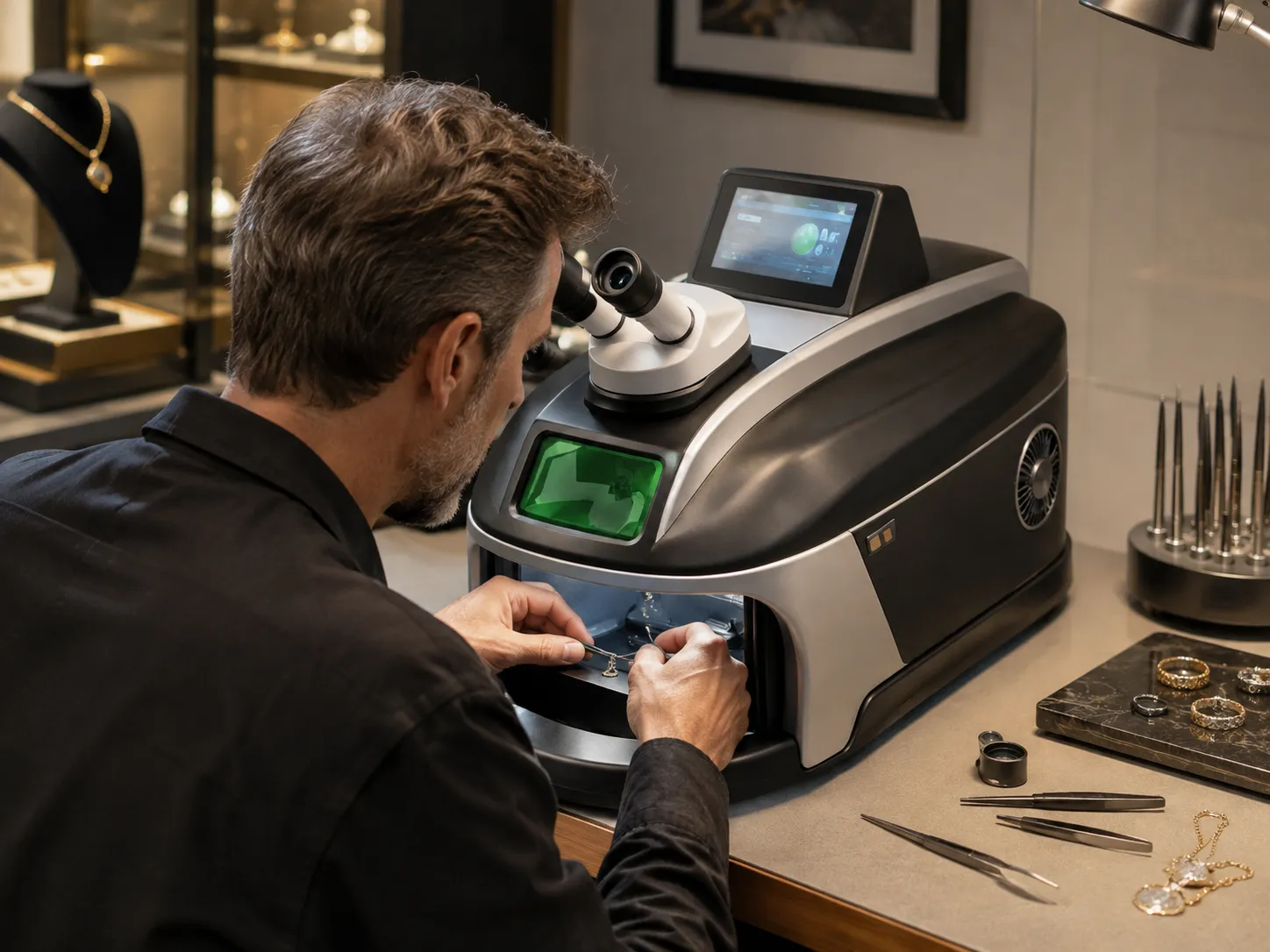
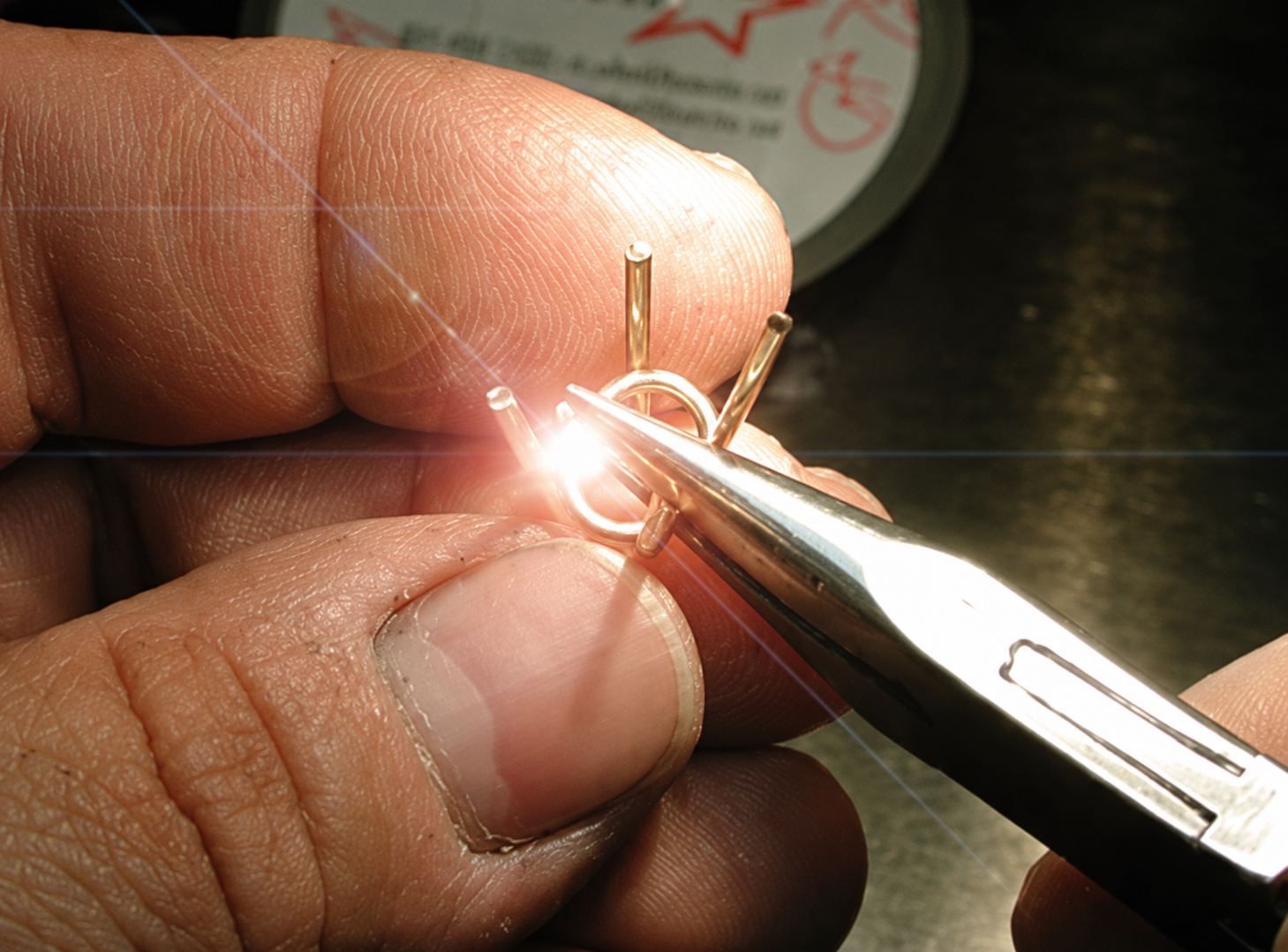
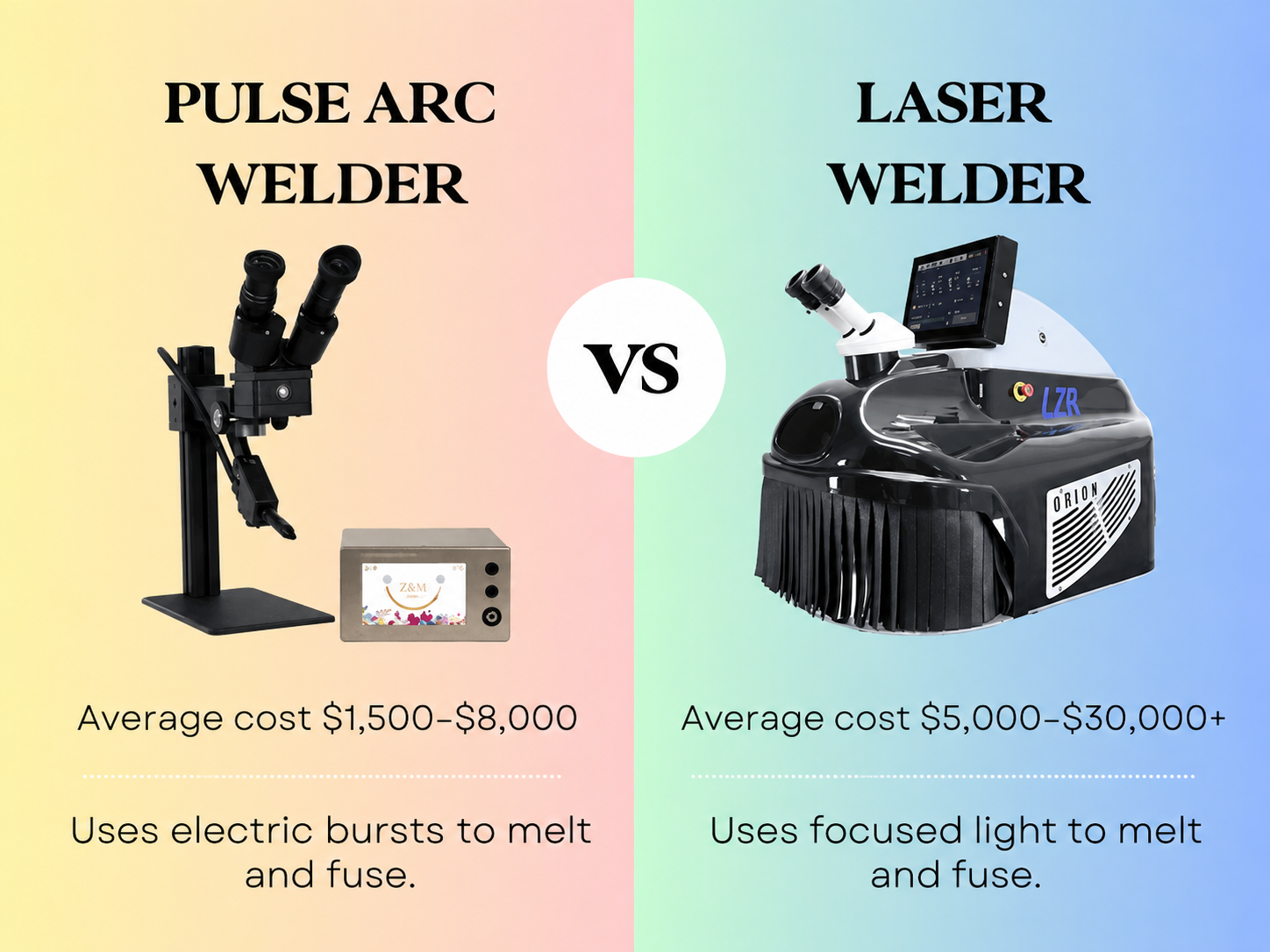
If you are choosing between a YAG and QCW fiber jewelry laser welder, the answer is not simply:
YAG for repair, QCW for production.
Both technologies can be used for jewelry repair, custom fabrication and precision welding. The real difference is how they deliver laser energy, how much maintenance the source requires, how compact the machine can be, and how well the system fits your daily workload.
For most jewelry buyers, the decision comes down to five questions:
What repairs do you perform most often?
How much control do you need on delicate pieces?
How many jobs do you weld each day?
How important are compact size and low maintenance?
What is your total budget—not just the machine price?
A traditional YAG jewelry laser welder remains a proven option for repair shops and goldsmiths. QCW fiber technology provides many of the same pulsed-welding capabilities in a more compact, efficient and lower-maintenance laser architecture.
IPG, one of the major fiber-laser manufacturers, specifically notes that QCW fiber lasers can produce the same types of welds traditionally produced by flashlamp-pumped Nd:YAG lasers. QCW systems can also deliver high peak power with millisecond-range pulses, making them suitable for precision welding rather than only continuous industrial production.
So which one should you buy?
Here is the quick answer.
If This Matters Most | YAG | QCW Fiber |
|---|---|---|
Traditional jewelry repair workflow | Excellent | Excellent |
Gold, silver, platinum repair | Excellent | Excellent |
Fine prongs, chains and small joints | Excellent | Excellent |
High pulse-energy flexibility | Strong | Strong, depends on source configuration |
Pulse-to-pulse consistency | Good | Excellent |
Compact machine design | Moderate | Better |
Air-cooled options | Limited on traditional systems | Common on compact QCW systems |
Source maintenance | Higher | Lower |
Flashlamp replacement | Usually required | No flashlamp |
Higher-volume repeat work | Good | Usually better suited |
First-time buyer focused mainly on repair | Often attractive | Also attractive if budget allows |
Lowest long-term maintenance | Moderate | QCW advantage |
The important point is that technology alone does not determine weld quality.
A well-designed YAG machine can outperform a poorly configured QCW machine, and vice versa.
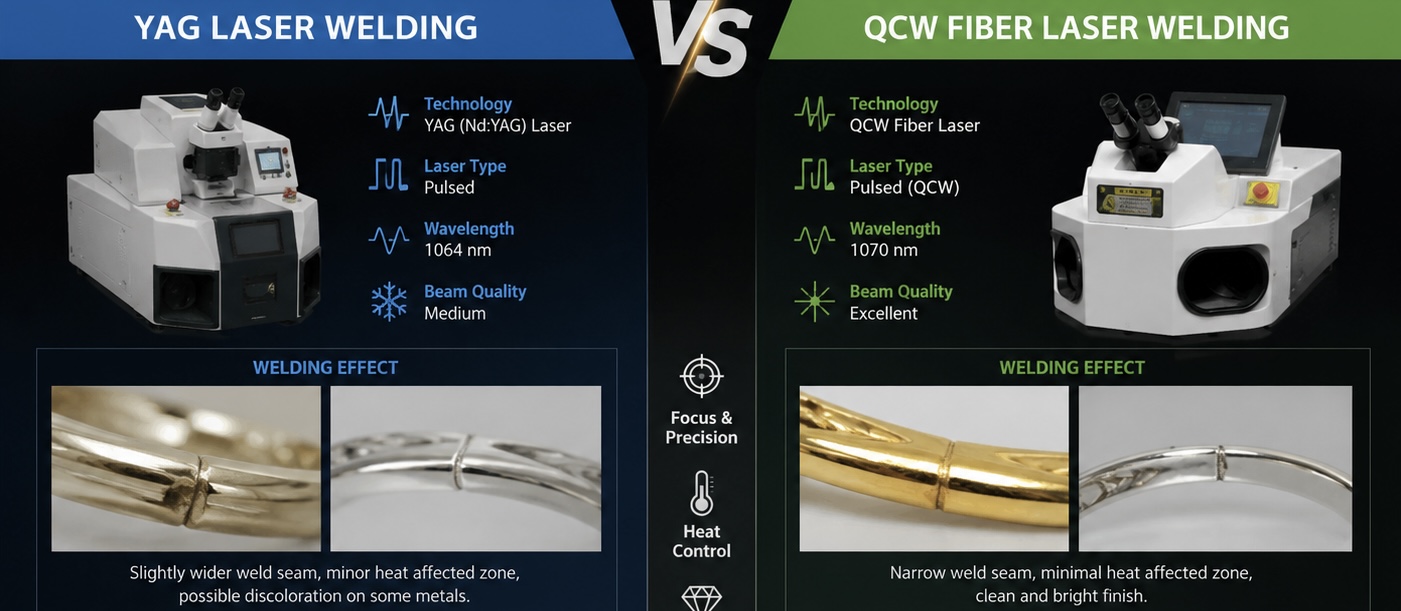
1. What Is the Real Difference Between YAG and QCW Fiber?
Both systems create short, concentrated bursts of laser energy that can melt a very small area of metal.
That is why both can be used for jewelry work such as:
Ring resizing.
Prong rebuilding.
Chain and clasp repair.
Porosity filling.
Bezel repair.
Custom fabrication.
Platinum repair.
Small production welds.
LaserStar, for example, describes jewelry laser welding applications including gold and platinum prong repair, bezel work, ring and bracelet resizing, porosity filling and repairs around stone-set jewelry.
The difference is mainly how the laser pulse is generated and delivered.
YAG: The Traditional Jewelry Welding Platform
Traditional jewelry laser welders commonly use a flashlamp-pumped Nd:YAG laser.
The architecture has been used in jewelry workshops for many years because it can generate strong, controllable pulses suitable for spot welding precious metals.
For a bench jeweler, that translates into good control over:
Pulse energy.
Pulse duration.
Spot size.
Weld depth.
Filler-wire addition.
This makes YAG suitable for everything from a fine prong repair to adding material to a heavier ring shank.
Its biggest disadvantage is not that it produces poor welds.
It is the hardware around the laser.
Traditional flashlamp-pumped YAG systems use components such as flashlamps, a laser resonator and cooling hardware. Those components increase machine size and introduce additional maintenance compared with a sealed fiber source. IPG's comparison of long-pulse fiber and conventional YAG specifically notes that QCW architecture eliminates the flashlamp and free-space resonator arrangement used in traditional YAG systems.
For a repair shop that is comfortable with YAG maintenance and values a familiar bench workflow, this is not necessarily a problem.
It simply needs to be included in the ownership decision.
QCW Fiber: Similar Pulsed Welding With a Different Laser Source
QCW means Quasi-Continuous Wave.
Despite the name, it should not be confused with a conventional CW laser running continuously.
QCW fiber lasers can produce millisecond-range pulses with peak power substantially above their average power. IPG's current QCW platform, for example, supports pulse durations from 0.05 to 50 ms on several configurations and peak power many times higher than average output.
That makes QCW well suited to localized welding.
The fiber architecture also changes the machine itself.
Instead of relying on a flashlamp and traditional resonator, the laser source is built around a sealed fiber system.
In practical workshop terms, this can mean:
Smaller source size.
Lower electrical consumption.
Less source maintenance.
Better pulse-to-pulse stability.
Air-cooled options on compact systems.
Fewer laser-source consumables.
That is why QCW has become increasingly attractive for a modern laser welder for jewelry when the buyer wants both precision welding and a simpler long-term maintenance profile.
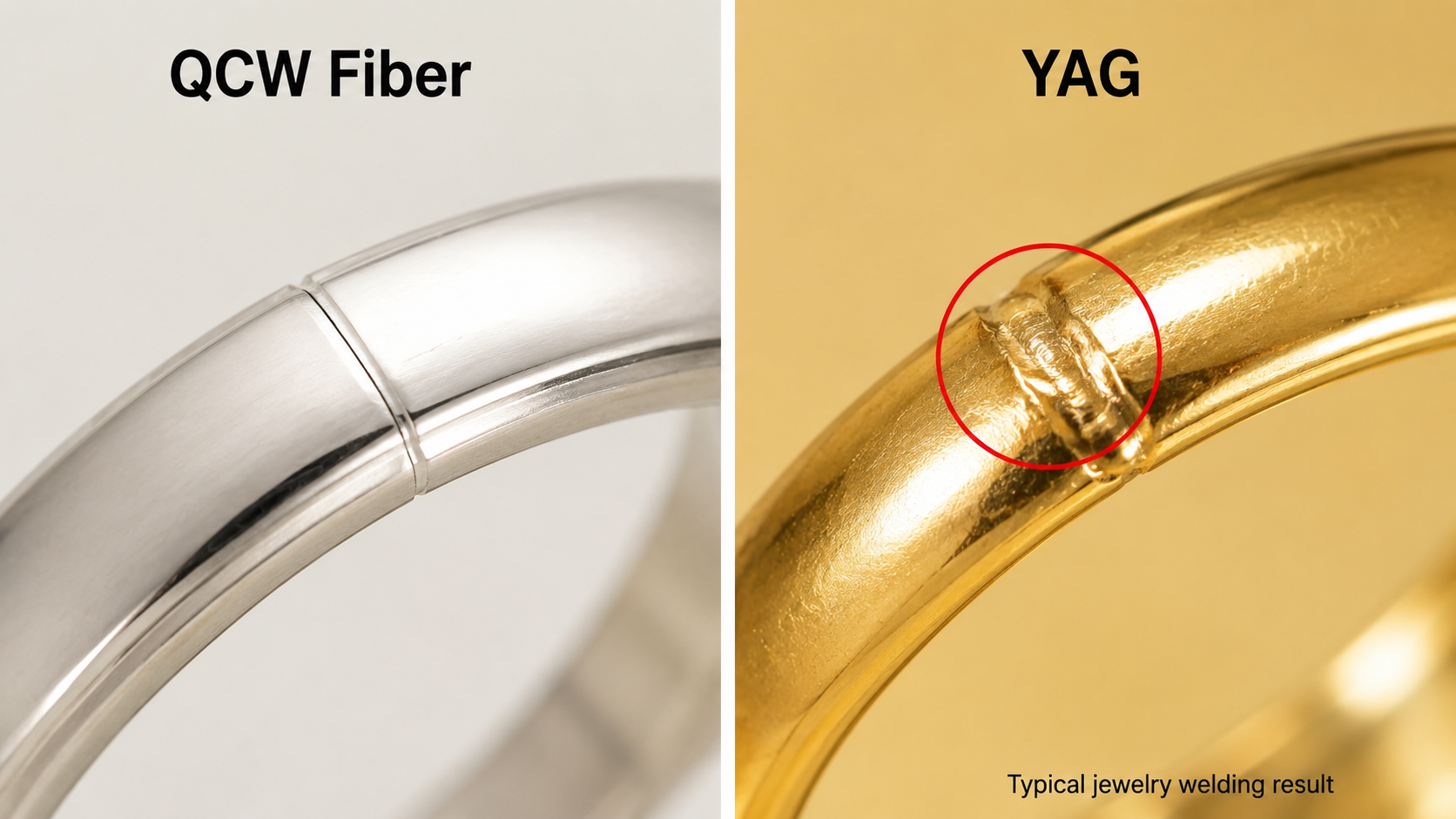
Is QCW More Precise Than YAG?
Not automatically.
This is one of the claims I would remove from the original article.
Precision depends on the complete machine, including:
Minimum spot size.
Pulse-energy adjustment.
Pulse-width control.
Optical system.
Microscope or camera.
Mechanical positioning.
Operator technique.
A QCW fiber source can provide excellent beam stability and repeatability, but that does not mean every QCW jewelry machine automatically produces a smaller useful weld than every YAG machine.
Likewise, YAG should not automatically be described as producing excessive heat.
Both systems can perform highly localized jewelry welding when correctly configured.
For buyers, the useful question is:
“Show me the smallest repeatable weld this actual machine can make on my jewelry.”
Not:
“Which technology theoretically has the smaller spot?”
2. Which Is Better for Jewelry Repair, Goldsmith Work and Production?
This is where the choice becomes much easier.
Think about the work sitting on your bench rather than the laser architecture.
Repair Shops
A typical repair shop may handle:
Ring sizing.
Broken chains.
Prong retipping.
Porosity.
Stone-set jewelry.
Gold one minute and silver the next.
A traditional YAG jewelry laser welding machine remains a very strong choice for this workflow.
It is mature technology, familiar to many bench jewelers and offers a wide adjustment range for one-off repairs.
But QCW is also a legitimate repair-shop option.
If you want a more compact system, lower source maintenance and strong repeatability, QCW may actually be the better long-term choice.
So the correct answer is:
Repair shop = YAG or QCW, depending on budget, workload and maintenance preference.
Not:
Repair shop = YAG only.
Professional Goldsmiths and Custom Studios
Goldsmiths and custom studios often care less about maximum production speed and more about control.
They may work on:
18K gold.
Platinum.
High-value stone settings.
Fine custom pieces.
Antique repairs.
Irregular one-off joints.
For these buyers, technology matters less than usable control.
Compare:
How small can the spot go?
How finely can energy be adjusted?
How easily can you see the weld pool?
How comfortable is the work chamber?
Can you control filler wire accurately?
Can you save useful parameter presets?
Both YAG and QCW can work very well.
If the studio performs moderate volume and wants the most familiar traditional jewelry-welding platform, YAG is still attractive.
If the studio values a compact footprint, low maintenance and newer fiber-source architecture, QCW becomes attractive.
High-Volume Jewelry Manufacturing
This is where QCW usually gains a clearer advantage.
Production environments care about:
Repeatability.
Long operating periods.
Stable output.
Lower maintenance interruption.
Energy efficiency.
Compact integration.
Consistent welding across hundreds of similar parts.
QCW fiber systems are particularly strong in these areas because the sealed fiber architecture provides stable pulse delivery without flashlamp replacement and with fewer source-maintenance requirements.
IPG specifically highlights pulse-to-pulse stability and reduced maintenance as advantages of long-pulse QCW fiber architecture compared with conventional lamp-pumped YAG systems.
That makes QCW particularly attractive for:
Chain manufacturing.
Repeated clasp welding.
Batch jewelry assembly.
Production repair lines.
Watch components.
Small precision components.
Automated or semi-automated welding.
If your business performs the same weld hundreds of times, consistency matters more than whether the operator likes the feel of a traditional YAG platform.
What About Gold, Silver, Platinum and Palladium?
Both technologies can be configured for the major precious metals used in jewelry.
Do not choose YAG or QCW simply because a supplier says:
“This one is better for gold.”
Instead, test your actual materials.
A useful sample set should include:
14K or 18K gold.
925 sterling silver.
Platinum.
Palladium if your shop handles it.
Your most delicate chain.
A typical prong.
A medium or heavy ring shank.
Silver is particularly useful as a test material because its high reflectivity and thermal conductivity can expose an underpowered or poorly controlled machine more quickly than an easy gold demonstration.
The right jewelry welder should handle the metal mix your customers actually bring to the workshop—not simply produce one impressive weld on prepared gold samples.
3. Which Costs More to Own: YAG or QCW Fiber?
This is one of the most important differences between the two technologies.
Do not compare only the purchase price.
Compare what happens over several years.
YAG Maintenance
Traditional flashlamp-pumped YAG systems may require attention to:
Flashlamps.
Cooling water or chiller components.
Optical alignment.
Protective optics.
Filters.
General calibration and servicing.
This does not mean YAG machines are unreliable.
Thousands of workshops have used them successfully for years.
It means there are more maintenance items associated with the traditional laser architecture.
If you already have technicians familiar with YAG, this may be perfectly manageable.
If you are a small repair shop with no technical staff, maintenance convenience may deserve more weight.
QCW Fiber Maintenance
A QCW fiber source removes several of those traditional components.
IPG describes its long-pulse fiber architecture as replacing the flashlamp, water-cooled resonator and free-space optical path with a sealed fiber system, while using long-life diode pump sources.
For the owner, this generally means fewer laser-source maintenance tasks.
You will still maintain the complete machine.
That may include:
Protective optics.
Cooling system where fitted.
Filters.
Microscope or camera.
Gas system.
Work chamber.
Motion components.
But the fiber source itself generally has a simpler maintenance profile.
Cooling and Workshop Space
Traditional YAG machines are often associated with larger water-cooled configurations.
QCW fiber sources can be significantly more compact, and IPG currently offers both air- and water-cooled QCW configurations, including air-cooled single-mode models.
For a small repair shop, this can matter.
If your bench space is limited, compare:
Machine footprint.
External chiller requirement.
Electrical requirement.
Noise.
Heat output.
Overall machine weight.
A compact QCW jewelry laser welder may be attractive in a small retail repair environment even if maximum production throughput is not your main goal.
Do Not Assume QCW Automatically Costs Less
Lower maintenance does not automatically mean lower total cost.
The machine purchase price may be different.
Accessories may differ.
Training and support may differ.
Replacement parts may differ.
That is why the useful comparison is:
Total Cost of Ownership = Purchase Price + Maintenance + Consumables + Repairs + Downtime
Ask both suppliers for the same information.
Do not compare a fully equipped QCW system against a stripped-down YAG quote.
4. How Do You Decide Between YAG and QCW Fiber?
Use your actual workflow.
Choose YAG If:
Most of your business is repair and custom bench work.
Your operators already know YAG systems.
You want a proven traditional jewelry-welding platform.
You value wide manual pulse control.
Your expected workload does not make source maintenance a major concern.
You find a YAG machine that performs your actual sample repairs better at your budget.
Choose QCW Fiber If:
You want lower laser-source maintenance.
Compact size matters.
You prefer air-cooled operation where available.
You process higher daily volumes.
Repeatability between parts matters strongly.
You expect the machine to run for longer production periods.
You want a modern fiber-source platform with strong peak-power capability.
You are willing to pay more upfront if the overall machine gives better long-term value.
If You Are Still Unsure, Ask These Five Questions
1. How many jewelry repairs or welds will I perform per day?
If you perform a small number of highly varied repairs, either system may work.
If you perform hundreds of similar welds, QCW's consistency and lower source maintenance become more valuable.
2. What percentage of my work is delicate repair versus repeat production?
More custom, one-off repair work makes machine ergonomics and parameter flexibility critical.
Higher-volume repeat work puts more weight on stability and uptime.
3. Do I have the space and maintenance capability for a traditional YAG system?
If yes, YAG remains a perfectly valid option.
If not, a compact fiber system may simplify ownership.
4. Which machine gives the better result on my actual jewelry?
This should outweigh almost everything else.
Ask both suppliers to weld the same:
Gold sample.
Silver sample.
Platinum piece.
Prong.
Chain.
Ring shank.
Then compare the result.
5. What is included in the price?
When comparing jewelry laser welder price, ask whether the quote includes:
Microscope or camera.
Cooling system.
Argon setup.
Training.
Spare parts.
Protective optics.
Shipping.
Warranty.
Technical support.
A cheaper machine is not cheaper if you have to buy half of the working setup afterward.
YAG vs QCW Fiber: Final Buyer Comparison
Buyer Type | Better Starting Point |
|---|---|
Small jewelry repair shop | YAG or QCW — compare price, maintenance and sample results |
Professional goldsmith | Either — prioritize control and actual weld quality |
Retail jeweler adding in-house repair | Compact YAG or QCW |
Custom jewelry studio | Either — sample test delicate work |
High-volume manufacturer | QCW usually has a stronger advantage |
Shop prioritizing low maintenance | QCW |
Shop already experienced with YAG | YAG can remain the practical choice |
Limited bench space | QCW often has an advantage |
Buyer choosing only from wattage | Neither — compare actual welding performance first |
Conclusion
There is no universal winner in the YAG vs QCW fiber jewelry laser welder comparison.
YAG remains a proven and highly capable technology for jewelry repair, custom work and precious-metal welding.
QCW fiber can perform the same general class of pulsed welding while offering advantages in compactness, efficiency, pulse stability and laser-source maintenance.
For a low-to-medium-volume repair shop, the better machine may simply be the one that gives you better control, training and support at the right price.
For a higher-volume operation, or a shop that prioritizes compact size and lower long-term maintenance, QCW fiber becomes increasingly attractive.
Do not make the decision from:
YAG vs fiber.
Make it from:
Your repairs → your metals → your daily volume → your maintenance preference → your sample-welding results → your total ownership cost.
The best laser welder for jewelry is the one that handles the work already sitting on your bench—not the technology with the more impressive sales pitch.
Before choosing between YAG and QCW, send JewelryLaserNova your typical gold, silver or platinum repairs, expected daily workload and budget. The team can compare suitable configurations and perform sample welding so you can evaluate actual weld quality before deciding which platform fits your workshop.