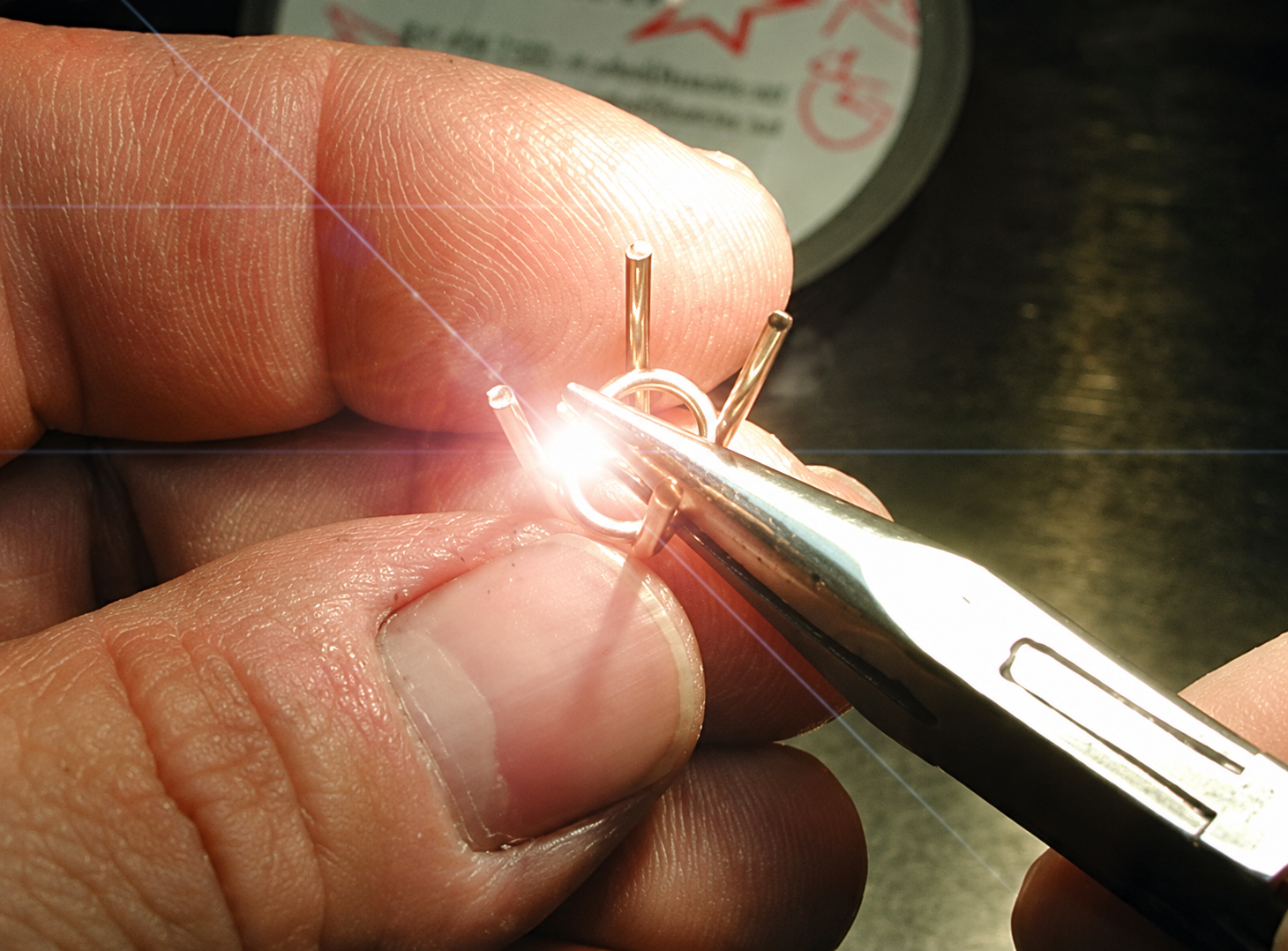
Yes, you can often laser weld jewelry with stones still in place.
That is one of the biggest advantages of a jewelry laser welder for repair work. Instead of heating a large section of the ring with a torch, the laser places energy into a very small area of metal. This can make repairs such as prong rebuilding, ring sizing and localized setting repair possible without automatically removing every gemstone first.
But “stones can stay in place” is not a universal rule.
The real decision depends on the type of stone, whether it has been treated, the condition of the stone, how close the repair is to the setting, how much metal must be welded and how well the laser parameters can be controlled.
For a repair shop or goldsmith, the safest question is not:
“Can this gemstone survive laser welding?”
It is:
“Can I complete this specific repair without sending unnecessary heat or laser energy into this specific stone?”
That distinction matters.
1. Which Stones Can Usually Stay in Place—and Which Should Be Removed?
Some gemstones are much more forgiving around localized jewelry repair than others, but no stone should be treated as automatically safe.
A practical starting point is:
Stone Type | General Approach Around Laser Welding |
|---|---|
Diamond | Often left in place when the stone is sound and the weld is localized |
Ruby / Sapphire | Generally among the more heat-tolerant gemstones |
Cubic Zirconia | Can often remain, but condition and mounting still matter |
Emerald | High caution; treatments and inclusions can increase risk |
Opal | Usually better removed when heat exposure is possible |
Pearl | Remove whenever practical |
Turquoise | High risk, especially if stabilized or treated |
Amber / Coral | Usually remove |
Fracture-filled or clarity-enhanced stones | Treat as high risk |
Foil-backed, dyed or unknown treated stones | Remove or avoid welding close to the setting |
The original draft correctly separates more tolerant stones such as diamond, ruby and sapphire from highly heat-sensitive materials such as pearl, opal, turquoise, coral and amber.
For working jewelers, however, treatment history can matter as much as the gemstone name.
A natural untreated stone and a fracture-filled, oiled, dyed or resin-stabilized version of the same general material should not automatically receive the same treatment on the bench.
This is particularly important with emeralds. Emeralds are frequently included and may be oil-treated, so even though some stone-in-place laser repairs are possible, they deserve much more caution than diamond, ruby or sapphire.
If you cannot confidently identify the stone or treatment, removing it is usually safer than experimenting on a customer's piece.
For a jewelry laser welder, the goal is not to prove that every stone can remain installed. The goal is to reduce unnecessary stone removal when the repair and stone condition genuinely allow it.
2. Why Can a Jewelry Laser Welder Work So Close to Set Stones?
The main advantage is localized heat.
Torch soldering heats a comparatively large area of the piece. A laser welder concentrates energy into a much smaller spot, allowing the jeweler to melt and rebuild the metal directly at the repair point while reducing the amount of heat traveling toward the rest of the setting.
That is why a laser welder for jewelry is particularly useful for repairs such as worn prongs, localized porosity, ring shanks and small setting defects.
However, localized heat does not mean zero heat.
Several factors determine whether the stone remains at low risk.
Distance from the repair matters. A weld on the back of a ring shank is very different from rebuilding metal immediately beside a stone seat. The farther the repair is from the stone, the easier it generally becomes to control heat reaching the setting.
Pulse energy and duration matter. More energy or longer pulses put more total heat into the metal. If the joint needs repeated high-energy pulses to fuse, the thermal risk to nearby stones increases.
Repeated passes matter. One localized pulse may create very little thermal spread, but repeatedly welding the same area can allow heat to accumulate.
Metal thickness matters. A heavy platinum shank and a thin gold prong do not distribute heat the same way.
Stone layout matters. A single isolated stone provides a different repair environment from pavé or channel settings where several stones sit close to the same weld area.
The original draft correctly notes that weld distance cannot be separated from power, pulse duration, metal thickness and clustered stone layouts.
This is why I would not publish a universal rule such as:
“Diamonds are safe at X mm.”
A professional jeweler should treat distance as only one part of the decision.
Never Aim the Beam at the Stone
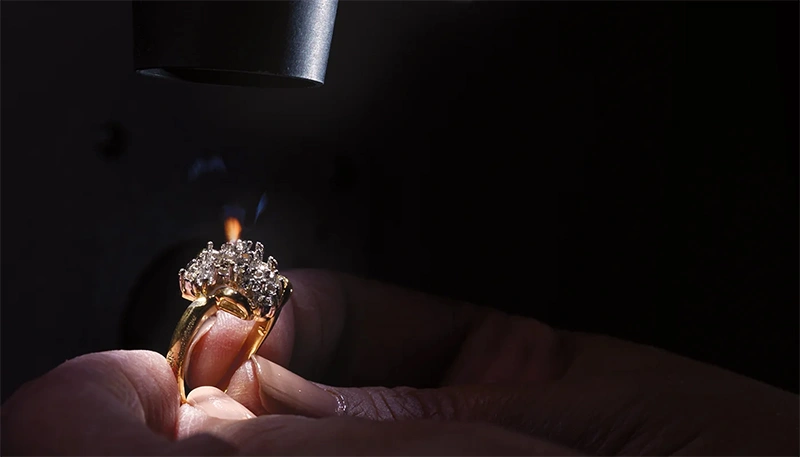
The laser should be aimed at the metal being repaired, not the gemstone.
The surrounding metal can help shield the stone while the laser is focused into the joint or filler material.
This sounds obvious, but it becomes especially important when working on very small prongs or crowded stone settings under magnification.
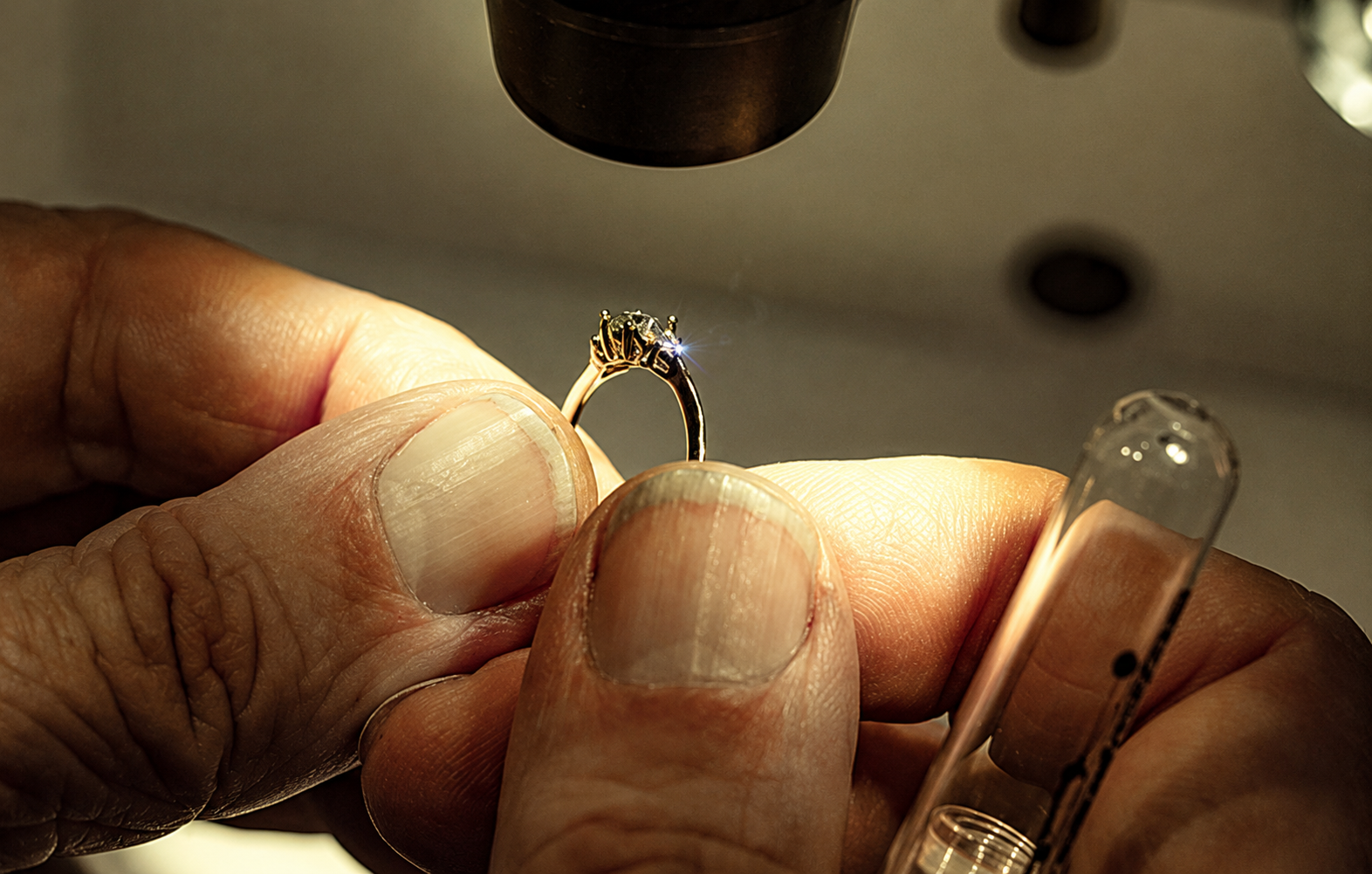
A good microscope or viewing system is therefore not simply a convenience feature on a jewelry laser welding machine. It is part of controlling exactly where the energy goes.
3. How Should Jewelers Laser Weld Near Stones?
For stone-in-place repairs, preparation matters more than chasing a universal parameter chart.
First, identify and inspect the stone. Confirm the gemstone type as far as reasonably possible, look for chips or visible inclusions, check whether the stone is loose and consider whether treatments may be present. If the stone is already compromised, do not make the laser repair the next stress event it experiences.
Second, inspect the joint and fit-up. A poorly fitted joint normally requires more filler, more pulses and more heat. Tight fit-up allows the repair to be completed with less energy.
Third, start conservatively. Use the lowest effective welding energy that produces stable fusion on that metal and joint. Short, controlled pulses are generally preferable to unnecessarily heating the same area for a long period.
The original draft recommends test welding on matching scrap, tack welding first and completing the repair in short sections rather than trying to create one long continuous weld beside the stone.
That is the right general workflow.
For example, on a prong repair, establish the correct settings on matching metal first, position the repair accurately under the microscope, tack the added material in place and then build the repair gradually.
If the metal begins accumulating excessive heat, stop and allow it to cool before continuing.
Do Not Copy One Universal Jewelry Laser Setting
This is especially important.
The original article provides fixed voltage, joule and pulse-width ranges for gold, silver, platinum and specific repair types. Those may describe certain machines, but they should not be treated as universal starting settings across all jewelry laser welders.
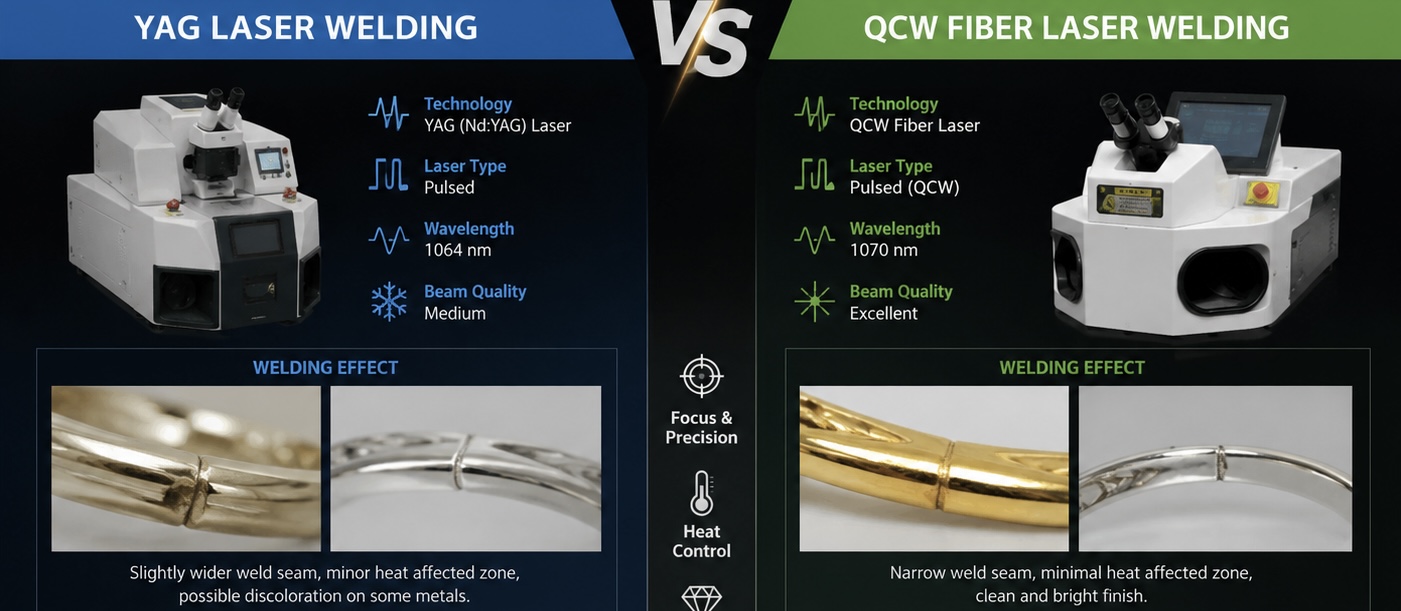
A YAG machine using voltage-based controls and a QCW fiber system using another control architecture may display completely different numbers while producing a similar weld.
Settings also change with:
Metal alloy.
Thickness.
Joint shape.
Filler wire.
Spot size.
Machine architecture.
Distance from the stone.
For that reason, a professional jewelry welding machine should provide enough adjustment range for the operator to develop a stable recipe for the actual work rather than rely on one number copied from the internet.
Use Shielding Gas Where the Metal Requires It
Argon shielding can help reduce oxidation and discoloration when welding materials such as gold, silver, platinum and other precious-metal alloys.
Good shielding can improve weld cleanliness, but it does not make an unsafe stone suddenly heat-resistant.
Stone protection and weld-quality control are separate issues.
Inspect the Stone Again After Welding
Do not finish the metal and assume the job is complete.
After welding, inspect:
The stone for chips, clouding, discoloration or other visible changes.
The setting for movement.
Prong tension.
The weld for porosity, undercut or incomplete fusion.
The alignment and symmetry of the repaired setting.
A successful stone-in-place repair protects both the jewelry and the stone.
4. When Should You Stop and Remove the Stone?
The ability to weld with a stone in place should never become a reason to avoid removal when removal is clearly safer.
The original draft correctly identifies several conditions where removing the stone deserves serious consideration, including heat-sensitive stones, damaged stones, pavé/channel arrangements and high-value pieces.
As a practical repair-shop rule, stop and reconsider the in-place repair when:
The stone type or treatment is unknown. If you cannot confidently identify what is in the setting, you cannot confidently predict how it will react.
The stone is cracked, heavily included or already loose. Existing weaknesses increase the risk of damage during any repair.
The stone is highly heat-sensitive. Pearls, opals, coral, amber and many treated stones are poor candidates for unnecessary heat exposure.
The repair is directly underneath or immediately beside the stone. Sometimes there simply is not enough metal between the weld pool and the gemstone to provide a comfortable process window.
Multiple stones are packed closely together. Pavé and channel settings can make heat management more complicated because several stones share the same small metal structure.
The piece is especially valuable or difficult to replace. Antique, heirloom and high-value jewelry deserves a more conservative repair decision.
The correct decision is sometimes:
“Yes, the laser could probably weld this—but removing the stone first is still the better repair procedure.”
That is not a failure of laser welding.
It is good bench judgment.
What Should You Look for in a Jewelry Laser Welder for Stone-Set Repairs?
If stone-set jewelry represents a meaningful part of your repair business, evaluate the machine around those jobs.
Look for:
Fine spot-size adjustment.
Precise pulse-energy control.
Adjustable pulse width.
Clear microscope or camera viewing.
Stable positioning.
Shielding-gas support.
Comfortable foot-pedal control.
Good low-energy performance.
Reliable parameter guidance and training.
Do not evaluate the machine only on its maximum wattage.
For delicate repair, the ability to produce a small, repeatable and controllable weld can matter much more than the largest possible pulse.
When comparing laser welding for jewelry, send suppliers representative stone-set samples—not only plain metal plates.
Ask them to demonstrate the exact jobs you expect to perform, such as prong rebuilding, ring sizing near a setting and localized repairs around diamonds or other stones.
Conclusion
Can you laser weld jewelry with stones in place?
Yes, in many repairs you can—and that is one of the major advantages of a jewelry laser welder.
But the correct answer is always conditional.
Whether the stone should remain depends on:
The stone type and treatment.
Its current condition.
The location of the repair.
The amount of heat required.
The metal and joint geometry.
The control available from the machine.
Diamonds, rubies and sapphires are commonly better candidates for stone-in-place work than highly heat-sensitive or treated materials, but even a relatively tolerant gemstone should not be treated as indestructible.
The safest workflow is:
Identify the stone → inspect the setting → test the metal → use the lowest effective welding energy → build the repair gradually → allow cooling when needed → inspect the stone and weld again.
And when the stone is unknown, compromised, highly heat-sensitive or directly in the thermal path, remove it.
The best laser welder for jewelry repair is therefore not simply the machine with the highest power. It is the machine that gives the bench jeweler enough control to complete delicate repairs accurately and repeatably.
If stone-set repair is an important part of your workshop, send JewelryLaserNova photos or samples of your typical ring, prong and setting repairs. The team can perform sample welding and help match a machine configuration to the metals, repair types and precision your bench actually requires.